
Bangladesh Institute of International and Strategic Studies
Bangladesh Institute of International and Strategic Studies
Experts: Bangladesh wins tariff relief, but challenges
remain
Publish : 24 Sep 2025, 19:04
Policymakers and trade experts hailed the recent tariff
agreement with Washington as a diplomatic breakthrough, while cautioning that
its long-term benefits would depend on structural reforms.
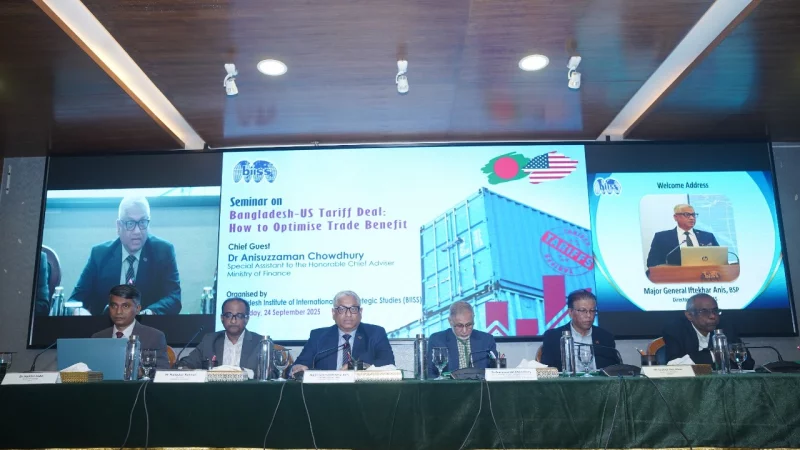
The Bangladesh Institute of International and Strategic Studies (BIISS) on
Wednesday hosted a seminar titled “Bangladesh-US Tariff Deal: How to Optimize
Trade Benefit” at its auditorium in Dhaka.
Special Assistant to the Chief Adviser on Finance Dr Anisuzzaman Chowdhury
attended as chief guest, and Commerce Secretary Mahbubur Rahman was present as
special guest.
Effective from August 1, the United States reduced reciprocal tariffs on
Bangladeshi exports to 20%, down from the previously threatened 35%–37%.
Speakers described the move as a “historic diplomatic victory,” bringing
Bangladesh’s tariff rate in line with regional competitors, including Vietnam,
Pakistan, and Cambodia.
However, participants stressed that lower tariffs alone would not secure
competitiveness.
Rising energy costs, port congestion, and compliance requirements continue to
challenge exporters, while overdependence on the US market leaves the economy
vulnerable to potential policy shifts in Washington.
Mahfuz Kabir of BIISS said that following the tariff deal, Bangladesh should
pursue a bilateral Free Trade Area (FTA) agreement with the US to broaden
exports without significant revenue loss.
He also noted that success would require addressing challenges such as labor
and human rights compliance, safety standards, regulatory reforms, and
intellectual property rights concerns.
During his presentation, Prof. Dr. Golam Rasul emphasized the need for market
diversification into Asean, the Middle East, and Africa; boosting
competitiveness through improved logistics and energy infrastructure;
maintaining balanced diplomacy; adopting labor and green standards;
strengthening financial resilience; and expanding industrial focus beyond RMG
to sectors such as IT, pharmaceuticals, agro-processing, and light engineering.
“The tariff cut gives our garment sector breathing space, but unless we fix
logistics and reduce lead times, orders could still shift to Vietnam or
Cambodia,” said Inamul Haq Khan during the open discussion.
Highlighting the potential for growth, Anisuzzaman Chowdhury remarked: “After
imposing tariffs, countries like Vietnam and South Korea have made significant
progress. In that context, Bangladesh can also achieve similar growth.”
He further highlighted the government’s recent initiative of providing all
required licenses and certificates for businesses from one single platform.
Experts urged the government to focus on export diversification, investment in
backward linkages for textiles, and stronger policy coordination among
ministries.
They also stressed the importance of expanding imports from the US to maintain
trade balance and avert renewed tensions.
While welcoming the breakthrough, participants concluded on a cautious
note.
“This is not a windfall,” one academic said. “It is an opportunity—and unless
we act decisively, it could slip away.”
Major General Iftekhar Anis, director general of BIISS, chaired the session and
delivered the welcome and concluding remarks.
Presentations were delivered by Dr. Mahfuz Kabir (BIISS), Prof. Dr. Golam Rasul
(IUBAT), and Inamul Haq Khan (BGMEA).