Davos 2026: Crisis in Global Order amid Competing Visions of
Peace and Power
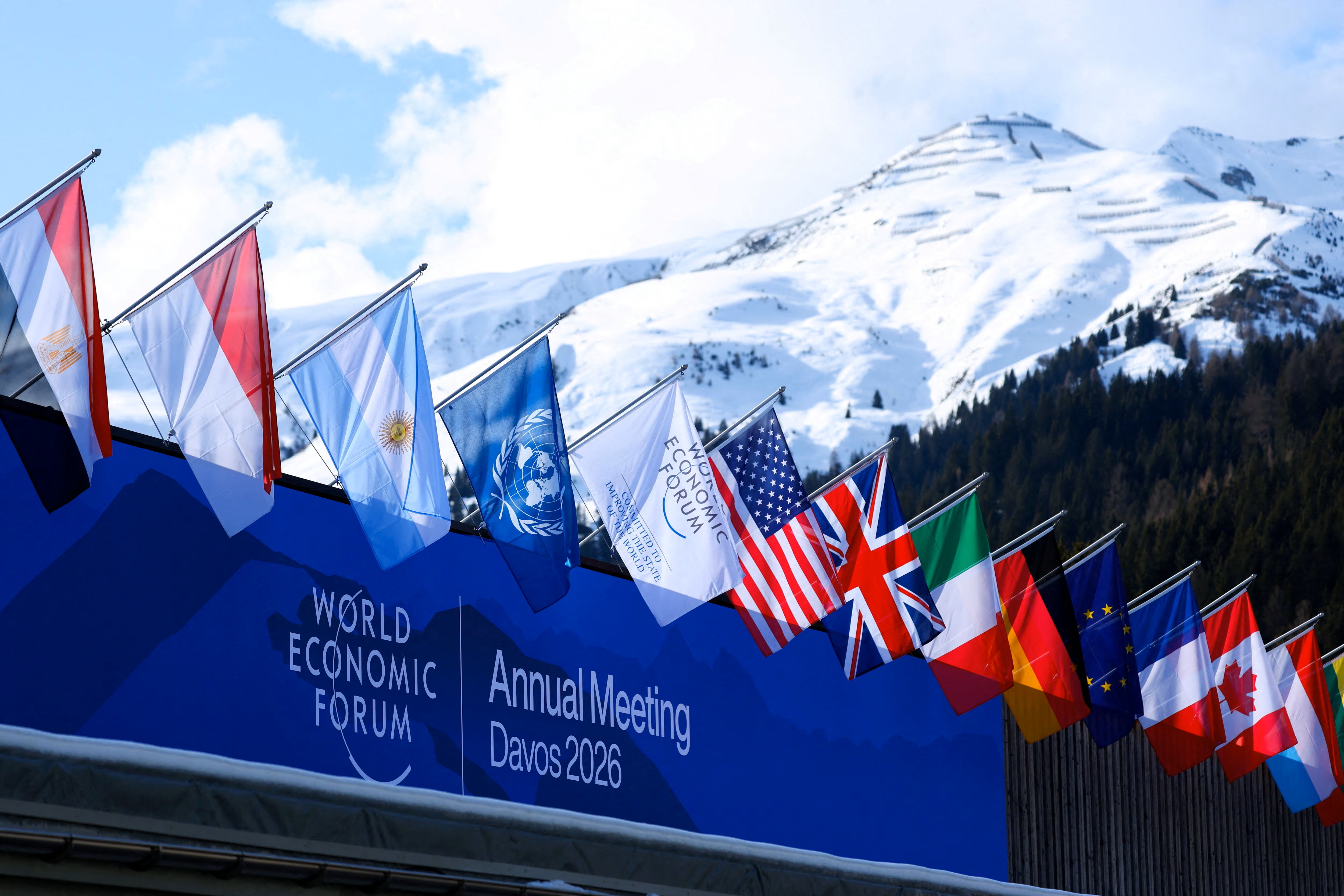
The Annual Meeting of the World Economic Forum 2026, held in Davos from 19 to 23 January,
convened under the theme “A Spirit of Dialogue” at a time marked by
intensifying geopolitical disorder. The formal agenda—fostering cooperation in
a divided world, unlocking new economic growth, investing in people,
responsible technological innovation, and sustainable development within
planetary boundaries—reflected an aspiration to restore confidence in
multilateral engagement. Yet the deliberations unfolded against a background of
geo-economic uncertainty, escalating trade and technology rivalries, cultural
and political polarization, and mounting climate anxiety. Rather than
reaffirming a coherent liberal order, Davos 2026 exposed its fragility. As
emphasized by Canadian Prime Minister Mark Carney, the contemporary
world order is in a state of rupture. Persistent geopolitical rivalries,
economic fragmentation, and declining trust in existing institutions to deliver
stability have shifted the international environment from consensus-based
globalization toward strategic competition. Cooperative frameworks that once
underpinned global integration are increasingly supplanted by rival industrial
policies, supply chain securitization, and assertions of strategic autonomy.
The meeting further highlighted the fraying transatlantic relationship,
particularly in light of tensions triggered by U.S. plans regarding Greenland
and renewed tariff threats against several European allies, including the
United Kingdom, Denmark, Norway, Sweden, France, Germany, the Netherlands, and
Finland. Simultaneously, Davos underscored the growing role of middle powers.
Carney’s intervention framed middle powers as potential stabilizers capable of
pragmatic diplomacy, coalition-building, and rules-based engagement in an era
of institutional paralysis. Another notable development was the open framing of
critical mineral cooperation as a matter of economic realism. Access to
critical minerals was treated not merely as a sustainability concern but as a
strategic imperative central to energy transitions, technological competitiveness,
and national security.
Two flagship reports of the WEF reinforced
this diagnosis of systemic strain of the global world order. The WEF’s Global Risks Report 2026 identified
geo-economic confrontation as the foremost global risk, signaling a world
increasingly prone to conflict and fragmentation. Meanwhile, the third edition
of the Global Cooperation Barometer, published since 2024, revealed a consistent decline in the pillar
related to peace and security. Together, these reports indicate that
cooperation is eroding precisely in domains where collective action is most
necessary. The intellectual architecture of Davos—long associated with
multilateral dialogue—thus coexisted with a growing normalization of skepticism
toward global institutions. This tension was dramatically illustrated by the
launch of U.S. President Donald
Trump’s proposed “Board of Peace” on the Davos
platform. Previously critical of the United Nations as ineffective and
overly bureaucratic, Trump’s initiative signaled a departure from strengthening
established multilateral peace and security frameworks in favor of a
leader-driven mechanism. Although linked in limited fashion to a UN Security
Council resolution concerning a Gaza ceasefire plan, the Board lacks
independent legal standing and broad-based democratic accountability. Its
structure—featuring a “Chairman for Life,” veto authority over membership and
agenda-setting, and a “pay-to-play” model requiring substantial financial
contributions for permanent membership—resembles a corporate boardroom more
than a diplomatic assembly. Legitimacy, in this conception, is not derived from
multilateral consent or adherence to international law, but from participation
incentivized by strategic calculation and alignment with U.S. power.

Such emergence of competing ideas
of peace and power due to the launch of President Trump’s “Board of Peace”
challenges the broader theme of Davos 2026. In the traditionally accepted
understanding embedded in multilateralism, peace is conceived as the absence of
violence achieved through justice, inclusive political processes, and
cooperation under international law. Power is exercised through rules, collective
decision-making, and institutional accountability. Conflict management
emphasizes diplomacy, dialogue, confidence-building, and long-term
reconciliation aimed at addressing root causes. Normatively, this model is
grounded in universal principles—respect for sovereignty, human rights, and
humanitarian standards—and institutionally anchored within the UN framework. By
contrast, the emerging interpretation embodied in the Board of Peace reframes
peace as deal-based stability: a temporary equilibrium secured through decisive
leadership, coercive leverage, and rapid transactional bargaining. Power is
conceived as an instrument of immediate political gain, including the potential
use of military might to reshape adversarial behavior. Legitimacy shifts from
legality and moral authority to effectiveness and control. Institutionally, the
Board privileges executive authority, speed, and hierarchical decision-making
over deliberative consensus. Substantively, it advances “peace through
construction,” prioritizing rapid reconstruction, private–public partnerships,
and economic investment to secure short-term stability, as reflected in its initial
mandate focused on Gaza. This approach, however, risks overlooking the deeper
social, political, and psychological dimensions of conflict that require
sustained engagement, reconciliation, and institutional reform. Its
exclusionary design and financial conditionality elevate economic power over
equal participation, signaling a departure from universal human rights
commitments and from the egalitarian ethos of multilateral diplomacy.
Davos 2026 therefore serves as
both mirror and catalyst of a transforming international system. It revealed
declining consensus, weakened multilateralism, and widening strategic rifts
among major and middle powers. The central question that emerges is whether the
global order is entering an era of power-driven peace—one in which stability is
pursued through authority, transactionalism, and executive dominance rather
than through norms, institutions, and collective deliberation. The coexistence
of these two paradigms—normative multilateralism and leader-centric
pragmatism—creates a hybrid and uncertain landscape. While results-oriented
frameworks may promise speed and decisiveness, their sustainability,
inclusiveness, and normative foundations remain contested. In this sense, Davos
2026 did not merely diagnose a crisis in global order; it illuminated the
profound contestation over the meaning of peace, the sources of legitimacy, and
the future architecture of international power.