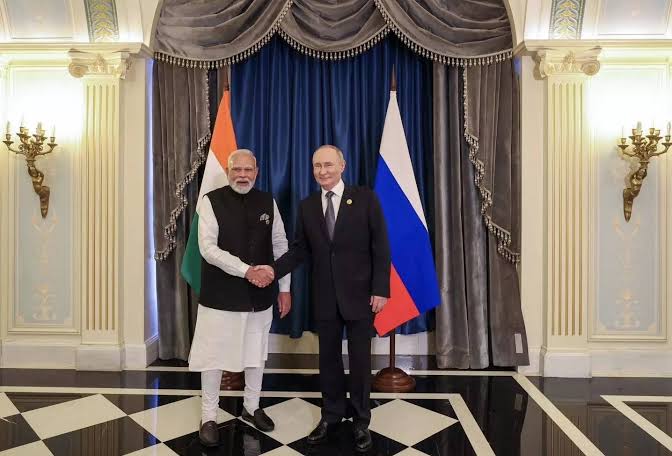
President Vladimir Putin’s state visit to New Delhi in December 2025 was more than a routine diplomatic engagement; it was a powerful statement of intent from two of the world’s major powers. Against a backdrop of geopolitical turbulence and Western pressure to isolate Moscow, the summit reaffirmed the “time-tested progressive partnership” between India and Russia, while simultaneously showcasing India’s unwavering commitment to its doctrine of strategic autonomy. The visit, Putin’s first since the 2022 invasion of Ukraine, not only solidified existing ties but also laid out an ambitious roadmap for the future, encapsulated in the “Vision 2030” agreement. This analysis delves into the key dimensions of this pivotal summit, exploring its implications for bilateral relations and the evolving global order.
The economic underpinnings of the relationship have undergone a dramatic transformation, with bilateral trade surging from under $10 billion pre-pandemic to an estimated $68 billion in 2024, largely driven by India’s increased imports of discounted Russian crude oil [1]. The “Vision 2030” plan aims to elevate this partnership further, targeting $100 billion in bilateral trade by the end of the decade [2]. This ambitious goal is predicated on a strategy of diversification, moving beyond the traditional pillars of energy and defense to encompass new areas such as nuclear energy, minerals, agriculture, and information technology. The proposed Free Trade Agreement (FTA) with the Eurasian Economic Union (EAEU) and the institutionalization of a rupee-rouble settlement mechanism are critical components of this strategy, designed to mitigate the impact of Western sanctions and reduce dependence on the US dollar [2].
While the economic partnership has gained new momentum, the defense relationship, historically the bedrock of India-Russia ties, is undergoing a period of recalibration. Although Russia remains India’s largest arms supplier, its share of Indian defense imports has declined from 72% in 2010–14 to 36% in 2020–24, as India diversifies its procurement and enhances its domestic manufacturing capabilities [3]. Nevertheless, key strategic programs, including the S-400 air defense systems and joint production of AK-203 rifles, underscore the continued importance of this defense partnership [3]. The summit also saw a renewed commitment to civil nuclear cooperation at the Kudankulam nuclear power plant, further cementing the strategic dimension of the energy partnership [1].

Geopolitically, the visit was a masterclass in diplomatic signaling. For Russia, it was an opportunity to demonstrate that it is not isolated on the world stage and that it retains powerful friends in Asia. For India, it was a powerful assertion of its strategic autonomy and its role as a “swing state” in an increasingly multipolar world. By warmly welcoming Putin, Prime Minister Narendra Modi sent a clear message that India will not be pressured into choosing sides and will continue to pursue a foreign policy based on its own national interests [4]. This delicate balancing act, however, is not without its risks. India must navigate the complexities of its relationships with the West, particularly the United States, which has already imposed tariffs on Indian goods in response to its purchases of Russian oil [4].
In conclusion, Putin’s visit to India has infused new dynamism into a long-standing partnership, setting an ambitious agenda for the future. The “Vision 2030” roadmap has the potential to transform the economic relationship, while the continued cooperation in defense and energy underscores the strategic convergence between the two nations. However, the success of this partnership will depend on India’s ability to navigate the treacherous currents of global geopolitics, balancing its ties with Russia against its relationships with the West. The path ahead requires not only trust and ambition but also a healthy dose of prudence and adaptability.
References
[1] Putin, Modi agree to expand
and widen India-Russia trade, strengthen friendship | Reuters https://www.reuters.com/business/aerospace-defense/russias-putin-hold-summit-talks-with-
indias-modi-delhi-2025-12-05/
[2] India & Russia vow to
scale up bilateral trade to 100 billion dollars by 2030 | DD News On
Airhttps://www.newsonair.gov.in/india-russia-vow-to-scale-up-bilateral-trade-to-100-billion-
dollars-by-2030/
[3] India-Russia oil and
defence ties | Reuters https://www.reuters.com/business/energy/india-russia-oil-defence-ties-2025-12-02/
[4] Putin’s India visit aims to reaffirm New
Delhi–Moscow relations – just as Trump applies
pressure to downgrade them | Chatham House – International Affairs Think Tankhttps://www.chathamhouse.org/2025/12/putins-india-visit-aims-reaffirm-new-delhi-moscow-
relations-just-trump-applies-pressure