
Bangladesh Institute of International and Strategic Studies
Bangladesh Institute of International and Strategic Studies
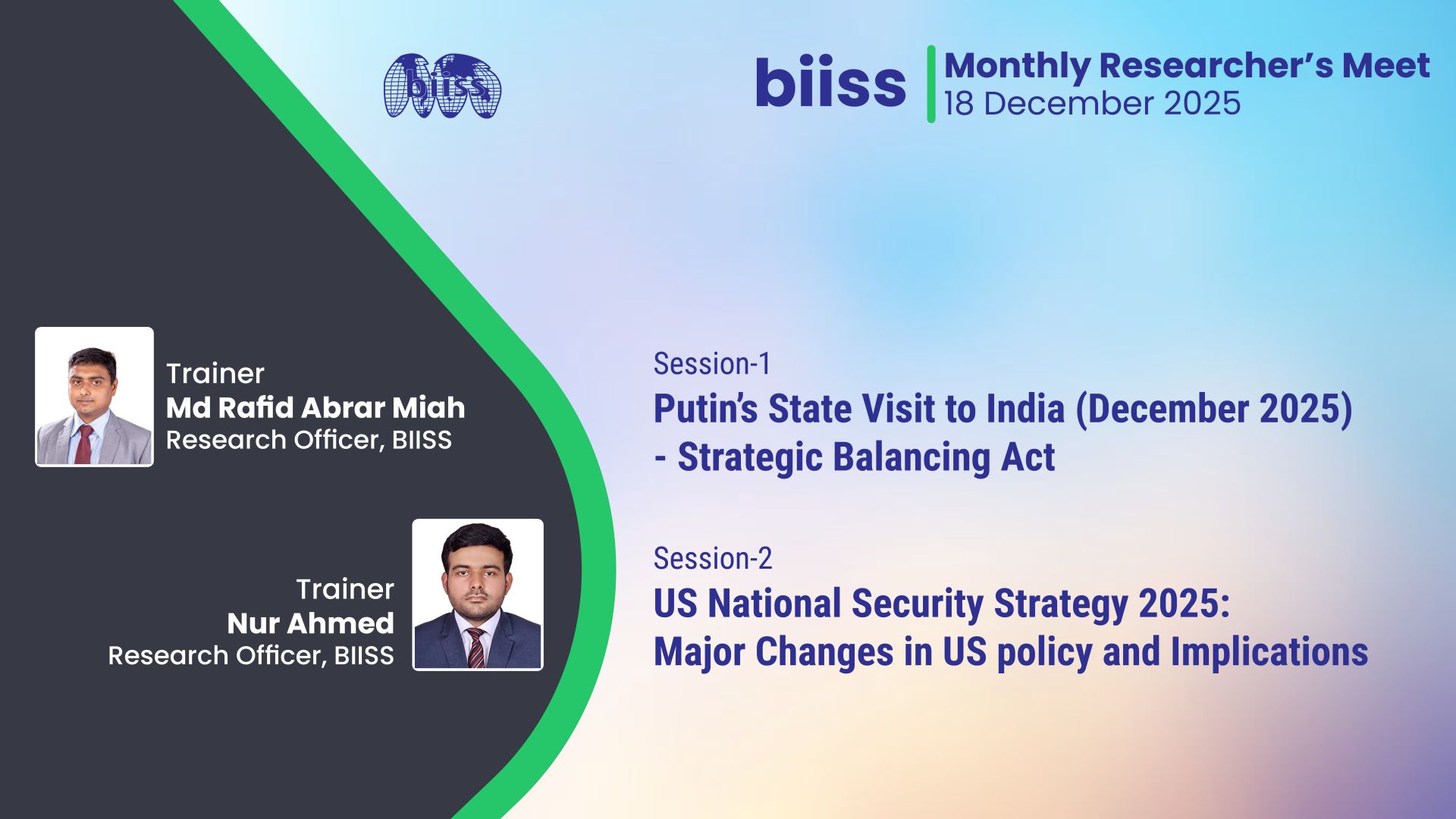
Title: Strategic Balancing Act: Putin’s State
Visit to India (December 2025)
Presenter: Md Rafid Abrar Miah, Research Officer
Event: In-House Monthly Research Meet
Date: 18 December 2025
The In-House Monthly Research
Meet examined the strategic implications of Russian President Vladimir Putin’s
state visit to India in December 2025, framing it as a calculated strategic
balancing act amid shifting global geopolitics. The discussion highlighted
how the visit reaffirmed the resilience of the long-standing India–Russia
strategic partnership despite mounting international pressures following the
Russia–Ukraine conflict.
The meet underscored that the
visit focused on deepening economic engagement, particularly in trade,
energy cooperation, and long-term connectivity initiatives, while cautiously
navigating the constraints imposed by Western sanctions. Energy security
emerged as a central theme, with Russia positioning itself as a reliable supplier
and India carefully balancing its economic interests with broader diplomatic
considerations.
From a strategic perspective, the
visit illustrated India’s continued pursuit of strategic autonomy and
multi-alignment, maintaining close ties with Russia while simultaneously
strengthening relations with the United States and other Western partners. For
Russia, the engagement with India served as an important signal against
diplomatic isolation and reinforced its outreach to major emerging economies.
Title: US National/Security Strategy 2025: Major
Changes in US Policy and Implications
Presenter: Nur Ahmed, Research Officer
Event: In-House Monthly Research Meet
Date: 18 December 2025
The In-House Monthly Research
Meet on U.S. National/Security Strategy 2025: Major Changes in U.S.
Policy and Implications, presented by Nur Ahmed, Research Officer,
examined the newly released 2025 U.S. National Security Strategy (NSS)
and assessed its major strategic shifts, underlying policy principles, and
global implications.
On December 4, 2025, the
U.S. government published the updated National Security Strategy, marking a significant
reorientation of U.S. national security policy under the Trump
administration. This document departs from previous U.S. post-Cold War
doctrines by centering on “America First” realism rather than liberal
internationalism, signaling a recalibration of U.S. foreign policy priorities
in response to evolving geopolitical and domestic pressures.
A cornerstone of the 2025 NSS is
the elevation of domestic security—including border control,
immigration, and counter-trafficking—to the level of national defense. The
strategy prioritizes homeland stability as the foundation of external
strength, a shift from prior doctrines that often leveraged overseas
engagement to manage domestic security challenges.
Economically, the NSS reflects economic
nationalism and self-reliance, with emphases on reviving U.S. industrial
capacity, securing critical supply chains, and reducing dependence on foreign
rivals (notably China). Technological competition—spanning semiconductors, AI,
and space—features prominently as a domain of strategic contestation.
Strategically, the 2025 NSS
heralds a more conditional approach to global leadership, wherein the
U.S. maintains influence but limits direct intervention to areas tied closely
to vital national interests. Allies are expected to share defense burdens,
and the U.S. focuses on regions like the Western Hemisphere and Indo-Pacific
while reducing emphasis on traditional theatres like the Middle East and Africa.
The Indo-Pacific remains a key
focus, with strategy documents underscoring efforts to counter China’s
influence—especially around the First Island Chain—and to strengthen
partnerships with regional actors. Enhanced U.S.–India cooperation is
highlighted as central to maintaining security and economic networks in the
region.
Notably, the NSS’s language and
priorities have triggered diverse expert reactions. Analysts argue the strategy
shifts U.S. foreign policy toward transactional alliances, accepts
relations with authoritarian states for stability and resource access, and
reframes regional roles rather than cultivating traditional liberal
partnerships.
In conclusion, the U.S.
National/Security Strategy 2025 reflects major shifts in U.S. policy
toward realism, domestic prioritization, economic nationalism, technology
competition, strategic burden-sharing with allies, and recalibrated regional
engagements. These shifts have broad implications for global security
architectures, alliance dynamics, and geopolitical competition across
regions—especially in the Indo-Pacific and Western Hemisphere.